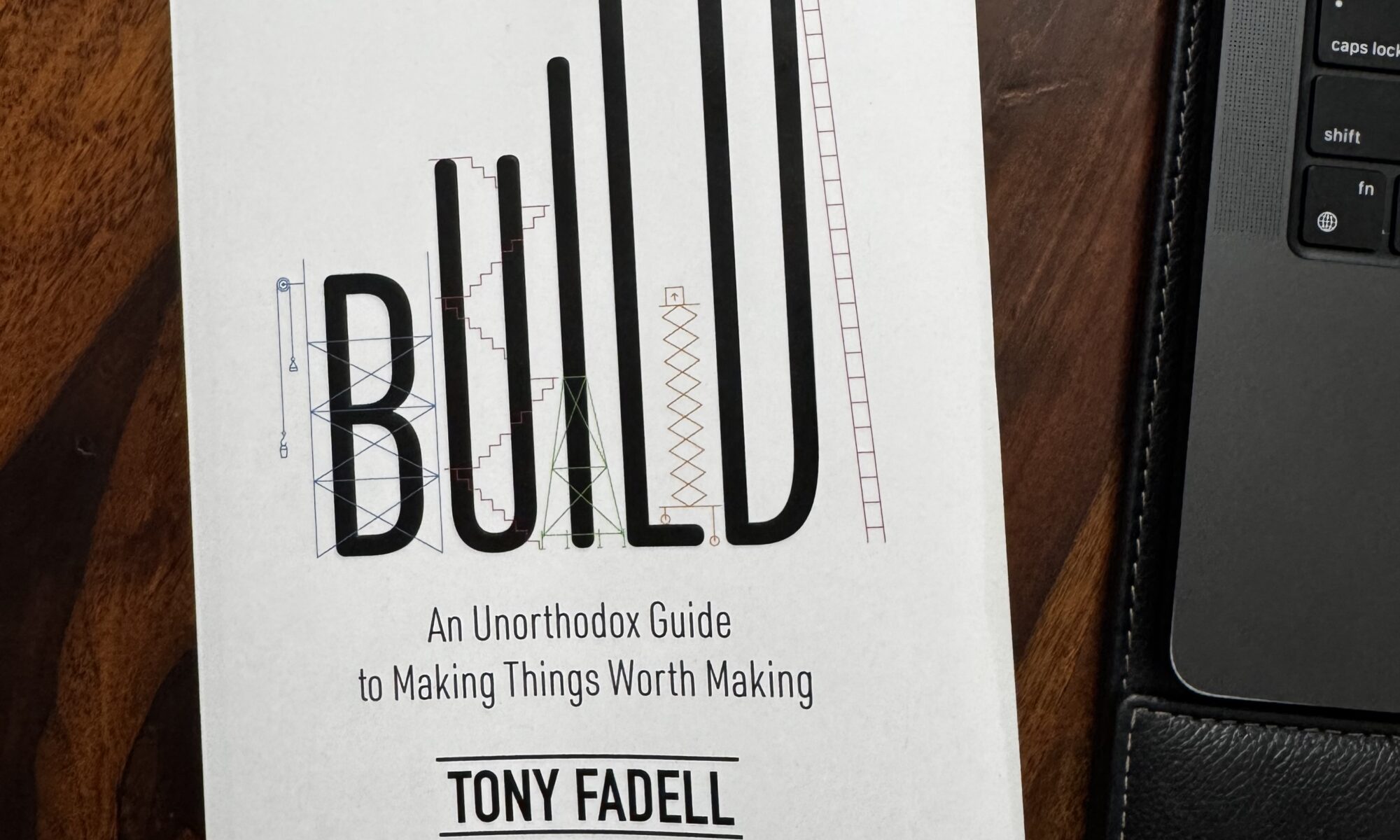
Book Review – Build, An Unorthodox Guide to Making Things Worth Making
First of all, this is going to be the last business book I am going to read. Unless there is some great biography out there – something like Steve Jobs by Walter Isaacson. Bill Gates’s life has unravelled in a way that I have much more respect for assholes than do-gooders; I have always hated saints, godmen and the like. Be more Christ-like and less Christian. Goes for followers of Guru Nanak as well.
Anyways back to the book. But before that I should review books that I read right after I have read them. The perspective is fresh and it can be lent and as it often happens taken. I spent over an hour looking for my copy of The Enchantress of Florence; Now I cannot go around asking and I am not going to spend to buy another copy. After all it is not Satanic Verses.
I am not sure how I leant of the book but I found it in the book store thanks to my man Ranjeet at the book store. He is a man who worked at the book store I bought books from earlier and I switched the store as he switched the job. Excellent man. I am not sure about his personal reading habits but he would always know what to recommend you. Think of him like the algorithm on amazon.com; but human. I guess more like the madam at your favourite brothel; she would not necessarily be sleeping with those ladies per se; but would definitely know your type.
This book is by a man who worked at General Magic; I could go on and on about General Magic but I won’t. In fewest words its the greatest technology company that you have probably never heard of and also a spectacular failure that gave birth to almost every modern innovation of today – from ecommerce to iPhone.
He had built Nest and was bought by Google, and built iPod and iPhone. And his name was famously deleted by Steve Jobs during the Macworld 2007
So yeah wealth of experience. You can learn more about him, here.
The book is about building things. It is a good guide woven around the life of the author, who by the way is the right person to talk about these things. I loved the book and I could relate because I love to build things, mostly software, but I do. And some of the software is profitable and puts food on my table.
The book is also about all other aspects around it. Hiring. Marketing. Legal. Dealing with VCs. Assholes at work. Breakpoints. Crisi. Quitting. Legal. Sales. Being a CEO and not being one. It is an easy read. Although close to four hundred pages. I started on Saturday and was done by Sunday Evening.
There are books you wish would go on for longer. This was not one of those. It had lot of good advice and the charts are off the charts. Something that I would be using from next day onward. I am going to make copies of it and find ways to reuse them for the products we are building and would be building in future. So yeah; lots and lots of good advice.
Finding Myself
My decision to not read any more business books is that they come from a place of privilege. A place I wasn’t born in, married into or invited to. A whole lot of advice that comes from these writings is from the place of privilege. It can be as simple as being born right. Choose your parents wisely, as I say.
But this book did arrive at the right time for me as well as my business journey. It helped me identify my role as product manager, even though I have more obligations within the organization. The book also laid a framework for other functions that I perform. Additionally, what duties I would take and what more I should delegate. I have been in a flux lately. Most of it good, and there are other areas that needs greater attention and I reckon the learnings would help.
The book opened the windows to a clearer mind and I can visibly see myself making the alterations I need without bringing in fundamental changes to how we operate – which again by the way was surprisingly similar.
What the author has been doing, I have been doing. At different scales altogether and doing totally different things but there is an element of similarity, the magnitude differs of course. And I felt confident about myself, and my professional life and of success and lack thereof.
That realization was critical and also sufficient. And this is not something you can confidently say about a piece of writing.
Epilogue:
I had also read Trillion Dollar Coach: The Leadership Handbook of Silicon Valley’s Bill Campbell and Bill Campbell was also a coach to Tony Fadell. I am not going to review that book but I would say that Build and Trillion Dollar Coach make for a great companions.